





Introduction: Visiting the Alhambra — history, art and Islamic symbolism
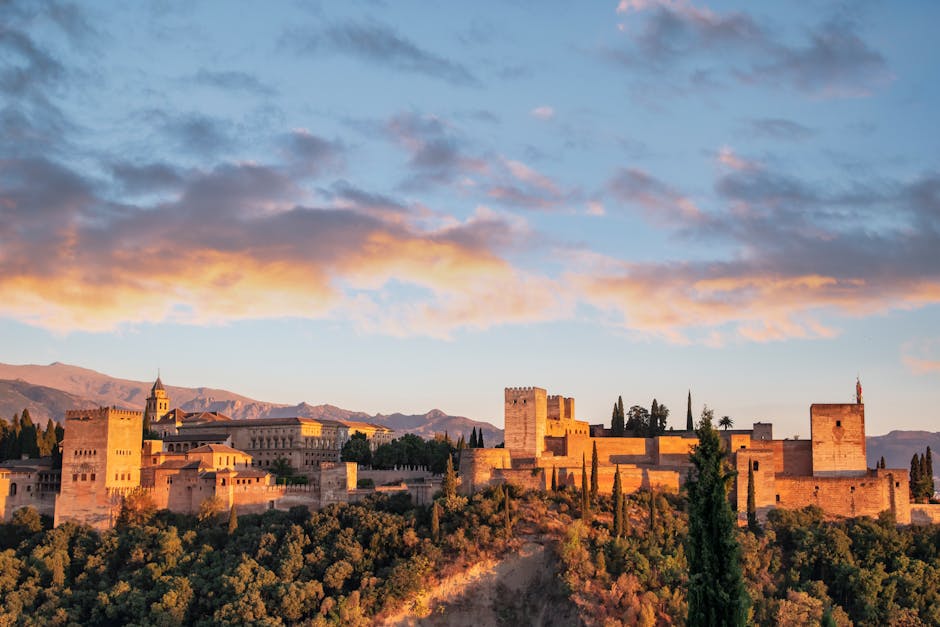
The Alhambra in Granada is more than a monument: it’s a vast book carved in stone and stucco, a palace-city that compresses centuries of history, aesthetics and symbolic thought. Perched on the Sabika hill overlooking the city of Granada and the Darro valley, the Alhambra is the finest expression of Andalusian-Moorish art — a place where architecture, calligraphy, geometry and gardening answer one another to create a unique sensory experience. As a visitor, understanding the balance between defensive function, royal residence and spiritual manifesto makes the visit far more rewarding.
This guide aims to give you a practical, immersive overview for visiting the Alhambra: its spatial layout (Alcazaba, Nasrid Palaces, Generalife, Palace of Charles V), useful addresses and opening times, typical prices and how to plan ahead. We’ll also describe the main sights to look for, the Islamic motifs and symbols to spot — from stars and scrolling foliage to inscriptions — and finish with local tips to help you make the most of your time and better understand what you’re seeing.
Visiting the Alhambra requires a little planning: visitor numbers are limited, especially for the Nasrid Palaces (the most ornate rooms and halls), and entry times are strictly enforced. It’s essential to book in advance, to know the routes between different sectors and to arrive with some pointers for reading the decorative elements. Beyond the practical details, it’s the site’s invitation to contemplation that stays with visitors: water whispering in the courtyards, the play of shadow and light on the muqarnas, calligraphic bands evoking the divine — all compose a multi-voiced narrative (architectural, vegetal, ornamental) that we’ll help you decode.
This guide is written for a general audience — not for archaeologists or specialists in Islamic art — but it remains professional and detailed. You’ll find immersive descriptions of the key spaces (Alcazaba, Nasrid Palaces, Court of the Lions, Generalife, Palace of Charles V), exact addresses, general opening times, indicative prices in euros and practical tips (access, routes, best times for photography). At the end, a set of local recommendations will help you extend the visit beyond the site: walks around the Albaicín, viewpoints and nearby food stops.
1) Site layout, addresses and practical opening times
The complex known as “Alhambra y Generalife” is managed by the Patronato de la Alhambra y Generalife. Here are the essential practical details to plan your visit.
Exact address: Patronato de la Alhambra y Generalife, Calle Real de la Alhambra, s/n, 18009 Granada, España. The site covers a large area on Sabika hill; the main entrance is at the bottom of Calle Real de la Alhambra, but different routes and access points punctuate the visit.
General opening hours:
- Opening hours (seasonal): April to October: 08:30 – 20:00; November to March: 08:30 – 18:00. These times can vary on public holidays and for special events.
- Nasrid Palaces: visits are organized in fixed entry slots (timed entry). Palace visit hours are generally between 08:30 and 20:00 in high season; you must enter during the time printed on your ticket.
- Night visits: there are evening time slots (Nasrid Palaces and Generalife) with variable hours (for example 22:00 – 23:30 depending on the season); these tickets are limited.
Tickets and indicative prices (public fares): note that prices may be changed by the Patronato; check the official site before purchasing. Indicative fares (current season):
- General Entry (Nasrid Palaces + Alcazaba + Generalife + Palace of Charles V): €14.00
- Nasrid Palaces entry (palaces only, timed entry required): €8.00
- Alcazaba + Generalife entry: €7.00
- Nasrid Palaces night visit: €21.00
- Reduced fares (youth, over 65, students under conditions): variable, generally between €3.00 and €9.00 — ID required.
Buying tickets: the official ticketing site is https://tickets.alhambra-patronato.es. Tickets are date-specific and, for the Nasrid Palaces, linked to a precise time slot; once your slot has passed, access is denied. Queues can be long: book online and either print your ticket or present it on your phone. If tickets are sold out on the official site, some local agencies sell guided tickets at higher prices.
Access and transport: from central Granada: bus C3 (runs between Plaza Isabel la Católica and the Alhambra) or C4 depending on route; stop “Puerta Real / Alhambra.” Many visitors prefer to walk up from the Paseo de los Tristes (about 20–30 minutes at a relaxed pace) to enjoy the views. There are also paid car parks nearby (Parque San Francisco and city public car parks), but access by car right up to the entrance is restricted and regulated.
2) Major sectors: Alcazaba, Nasrid Palaces, Court of the Lions and Palace of Charles V
The Alhambra is made up of several distinct sectors, each telling part of the Nasrid dynasty’s story or reflecting successive uses through the centuries. For a full visit, allow at least 3 to 4 hours. Below we detail the main areas and what they represent.
Alcazaba (Fortress)
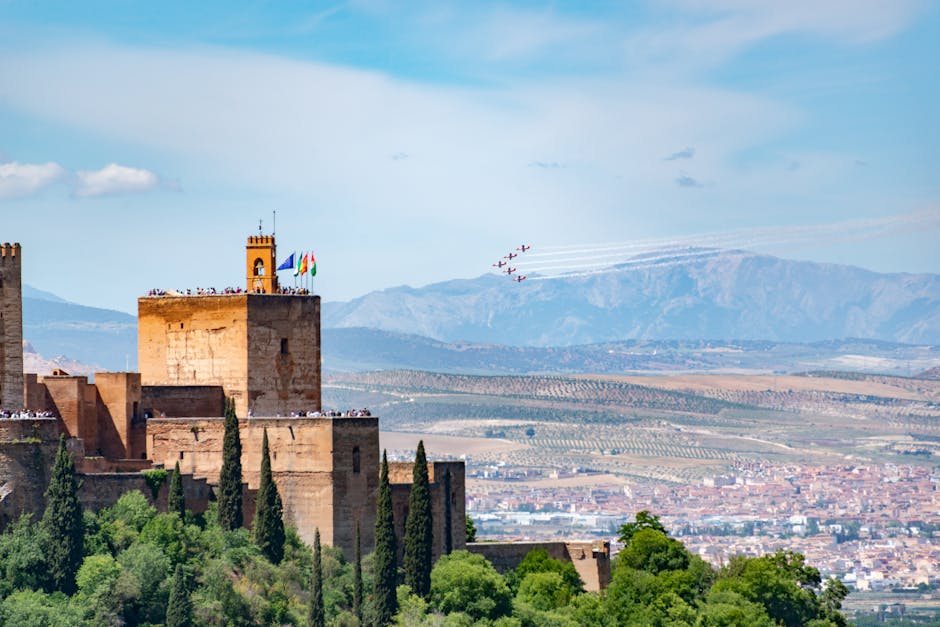
The Alcazaba is the oldest, most defensive part of the complex. Located at the western tip of the citadel, it served as the military camp and protective keep. Climb the towers — the Torre de la Vela is the best known — for panoramic views over Granada, the Albaicín and the Sierra Nevada. Access is via walls and steps; the ground can be uneven. The atmosphere is dry and stony, and the views more than justify the climb.
Nasrid Palaces
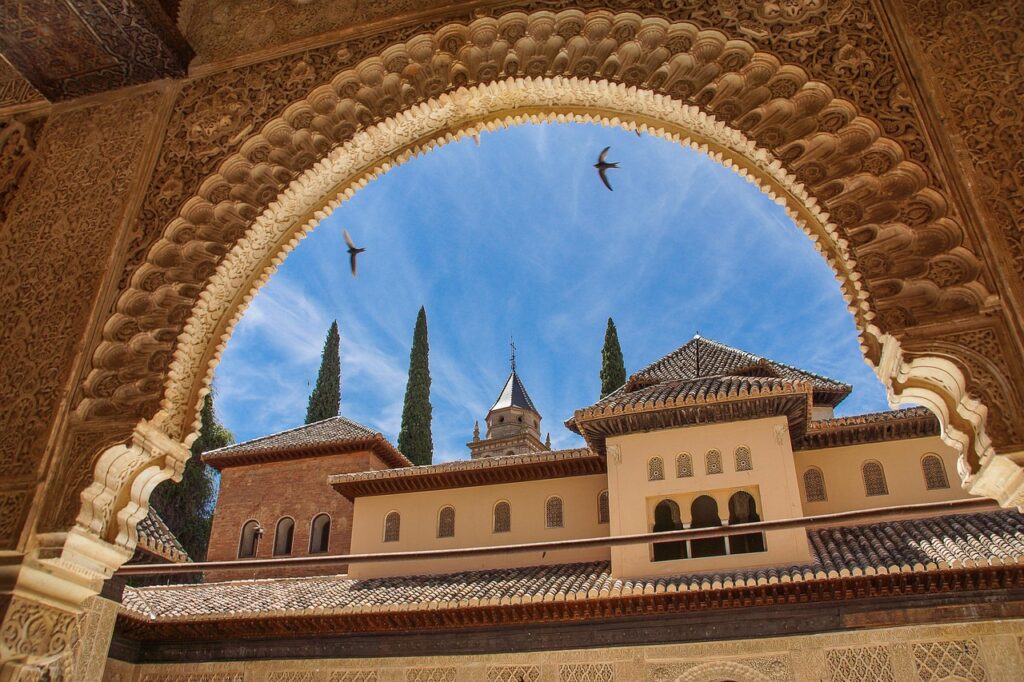
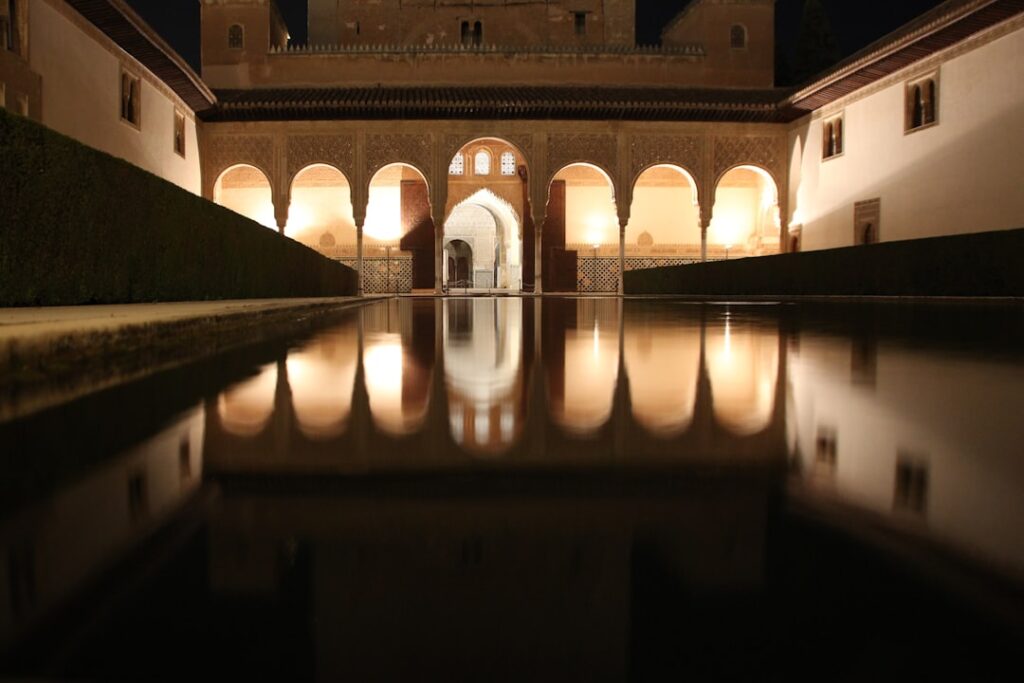
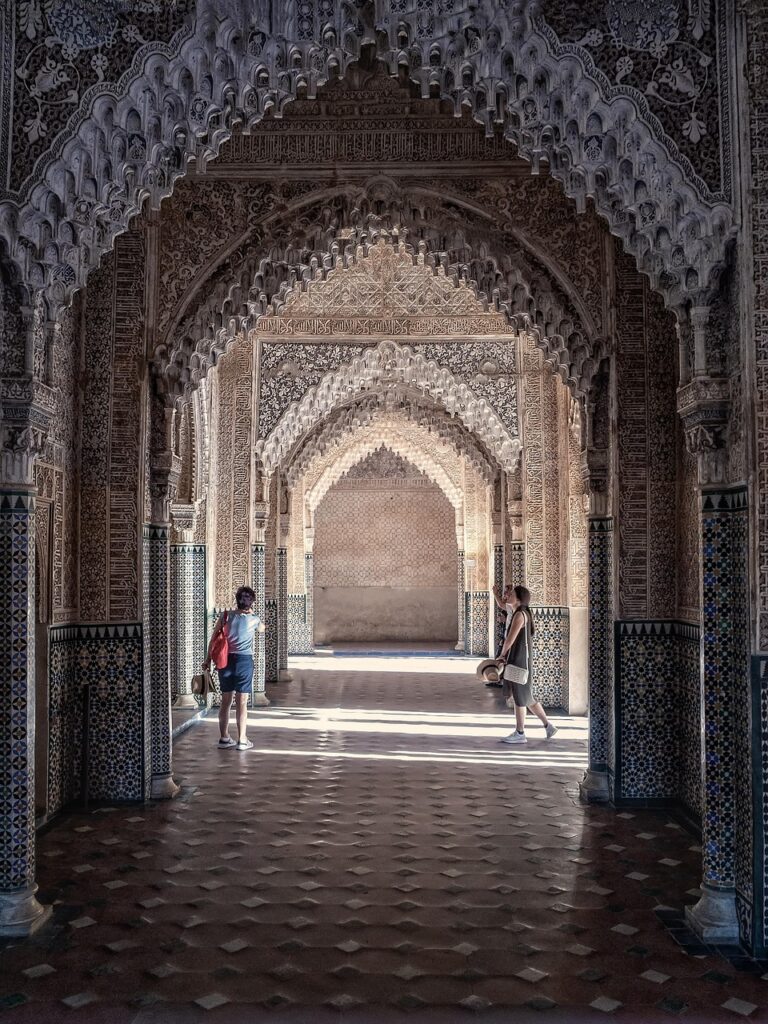
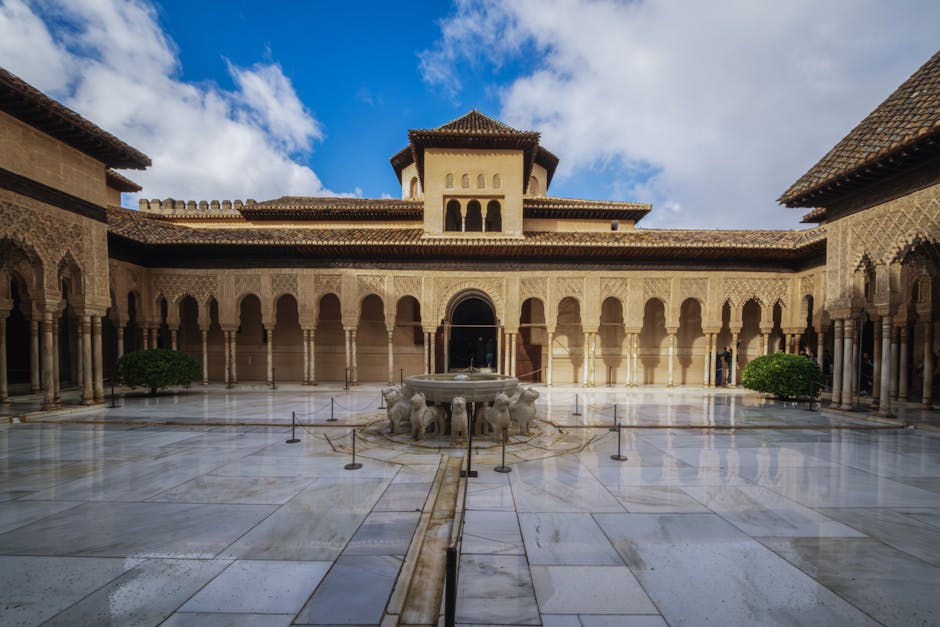
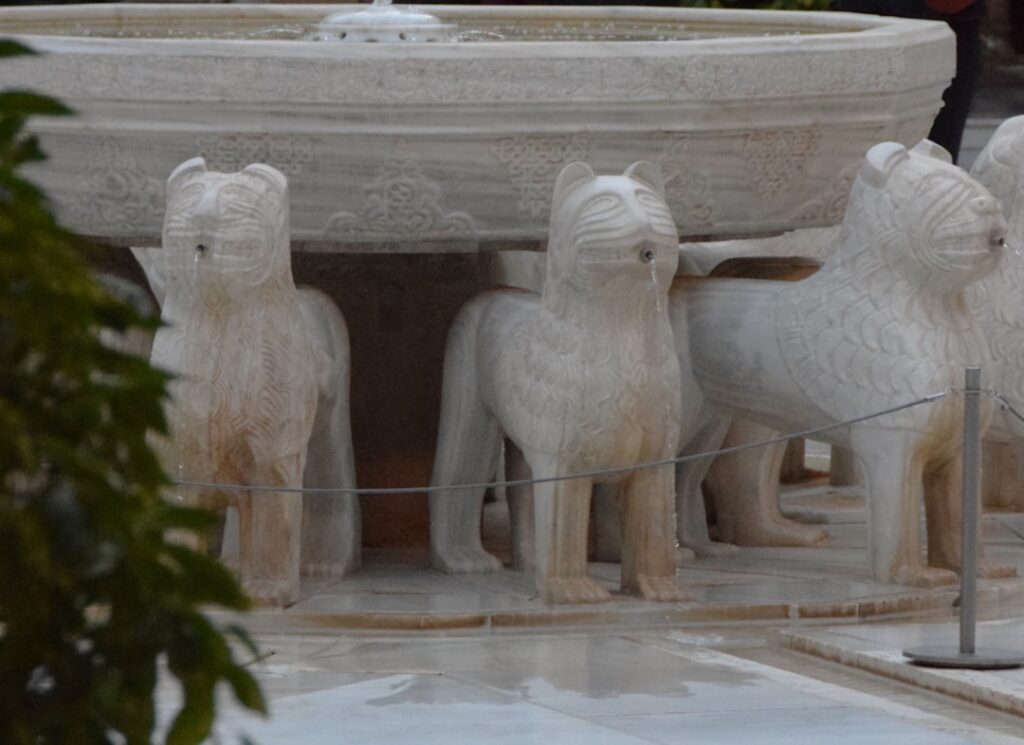
The Nasrid Palaces are the residential and ceremonial heart. These are the richly decorated rooms (Mexuar, Hall of the Ambassadors, Hall of the Abencerrajes) and the courtyards (Court of the Lions, Court of the Myrtles). Here, muqarnas, finely carved stuccowork, wooden panels, polylobed arches and calligraphic inscriptions combine to create a decorative language that promotes harmony and transcendence. The Court of the Lions, with its central fountain borne by twelve white marble lions, symbolizes balance and a miniature paradise.
Palace of Charles V
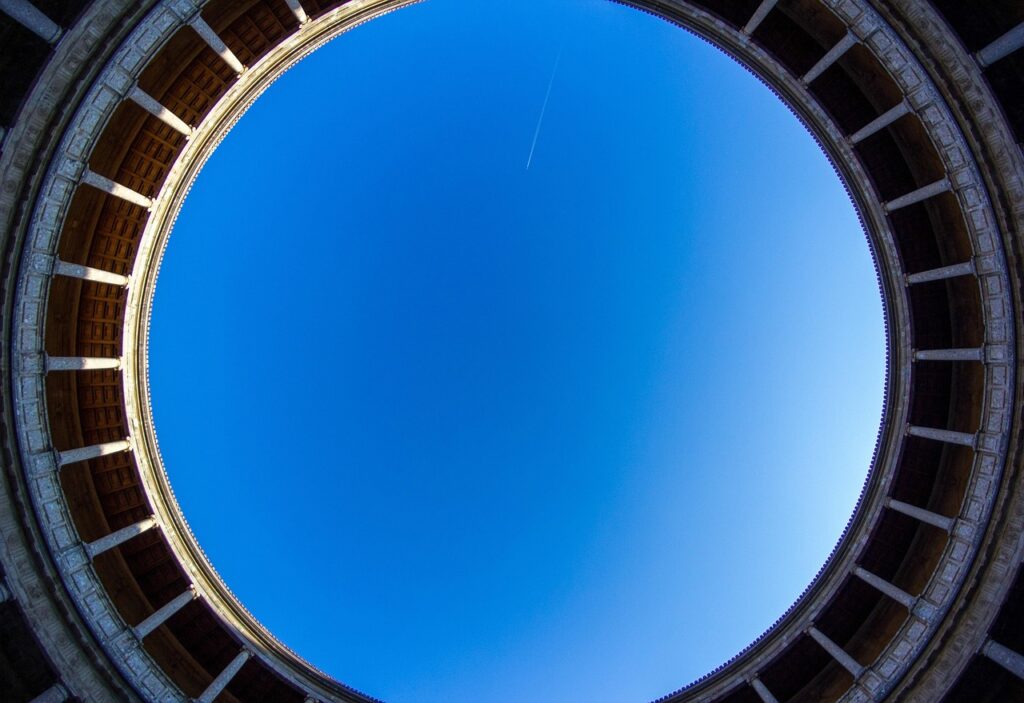
Built against the Nasrid Palaces, the Palace of Charles V is a Renaissance imposition ordered by Charles V after the Reconquista. Address: Patio del Palacio, Alhambra, 18009 Granada. This square building with its Roman-inspired architecture contrasts sharply with the surrounding Islamic ornamentation: a severe exterior and a monumental circular interior courtyard. The palace now houses the Alhambra Museum and the Fernández-Puertas Collection; visiting offers the post-Conquest, Christian perspective on the site.
Each of these sectors reads like a historical layer. The contrasts — stone and stucco, fortress and gardens, Renaissance austerity and Islamic decoration — tell the story of Granada’s transition from the Nasrid kingdom to a unified Spanish state. To understand the Alhambra, walk slowly, look for Arabic inscriptions praising the divine, and let your eye wander between geometric patterns and water features.
3) The Generalife and the gardens: an aesthetic of paradise
The Generalife was the summer residence of the Nasrid emirs and the quintessential pleasure garden. Its name likely comes from the Arabic jannat al-ʻarīf (garden of the architect or gardener). Situated on the eastern slope of the site, the Generalife combines terraces, pools, channels and planted beds of orange trees, cypresses and fragrant flowers. The ensemble functions like a theatrical landscape; water is the guiding thread: irrigation channels, jets and pools multiply light and sound.
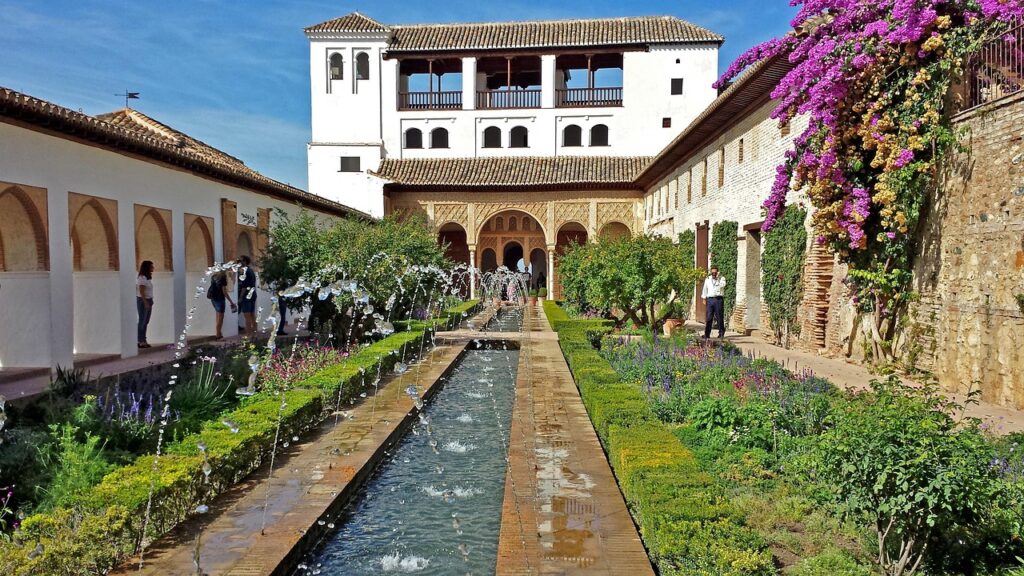
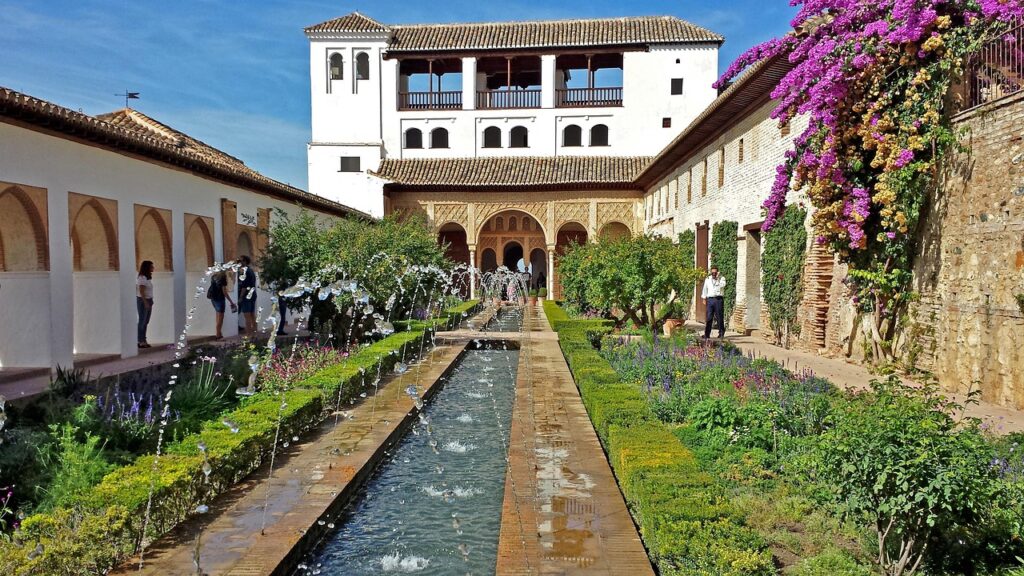
The Generalife gardens are arranged in successive terraces: the Patio de la Acequia (Court of the Long Water Channel) is the best known, featuring a long basin bordered by symmetrical flowerbeds. The intended effect is that of a garden-paradise, an image of the Quranic paradise where water, shade and vegetation offer refuge. The plants — orange trees, jasmine, roses — add olfactory layers that complement the visual experience.
Practical tips: the Generalife is generally visited either before or after the Nasrid Palaces, depending on your route. In hot weather (summer), favor the morning to avoid the heat; in high season there are fewer people early and the low light beautifully enhances the pools. Paths can be paved and sometimes slippery; wear comfortable shoes. For photographers, late afternoon provides warm tones and stronger reflections.
Symbolically, the gardens echo the palaces’ decorative language: ordered geometry, repetition of elements and controlled use of water all express a desire for a microcosm of order — a human space projecting an idealized image of the world. This connects with the palaces’ inscriptions, often centered on harmony and praise.
4) Reading Islamic symbols: calligraphy, geometry, arabesques and water features
The ornament of the Alhambra is a codified visual language. Learning to pick out symbolic elements lets each room and courtyard reveal deeper meaning. The motifs generally fall into three complementary groups: calligraphy, geometry and vegetal motifs (arabesques). Water and light act as agents that enliven these forms.
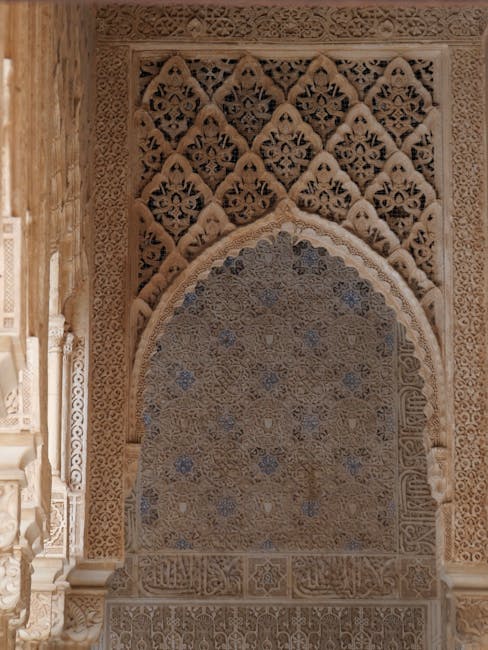
Calligraphy: Arabic inscriptions, often in cursive epigraphic scripts (thuluth, kufic), praise God, celebrate the ruler’s qualities or express maxims of wisdom. In rooms like the Hall of the Ambassadors, calligraphy frames messages of political and spiritual legitimacy: power is presented as subordinate to a divine hierarchy. Look for epigraphic bands above arches and along walls.
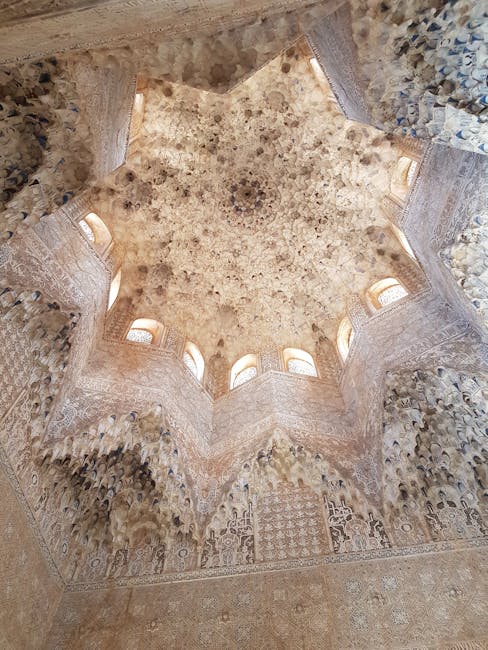
Geometry: Geometric motifs — stars, polygons, interlaced networks — fulfill an aesthetic and philosophical need: mathematical order evokes the divine perfection manifest in the universe. These patterns appear in friezes, tiles, ceilings (muqarnas) and allow immense decorative freedom without figurative representation (respecting aniconic conventions in Islamic religious art).
Arabesques and vegetal motifs: Stylized scrolls and palmettes create an endless rhythm, a metaphor for renewal. The Generalife gardens extend this language at full scale, with plants arranged in repetitive schemes.
Water features: The fountain in the Court of the Lions, the channels in the Generalife, reflective pools — all use sound and reflection to shape perception. Water moderates temperature, amplifies a sense of coolness and creates reflective perspectives; it is also a metaphor for purity and paradise.
To interpret these elements during your visit, follow these steps: 1) read the inscription bands (often translated on-site or in guidebooks); 2) observe the repetition and tessellation of patterns; 3) notice the water axes that structure the courtyards; 4) allow time to appreciate the changing light throughout the day. A knowledgeable local guide can greatly enrich symbolic readings, especially for calligraphy and historical context.
Conclusion: Prepare your visit, respect the site and extend the experience
Visiting the Alhambra is stepping into a multisensory, historical and spiritual experience. This guide has given you the essentials: the address and opening hours of the Patronato de la Alhambra y Generalife (Calle Real de la Alhambra, s/n, 18009 Granada), practical ticketing information (online purchase recommended via tickets.alhambra-patronato.es), indicative fares in euros for the various options (General Entry ≈ €14.00, Nasrid Palaces ≈ €8.00, combined and night entries priced higher) and a detailed description of the main sectors (Alcazaba, Nasrid Palaces, Generalife and Palace of Charles V). You now know where to look for symbolic messages: calligraphy, geometric designs, arabesques and, of course, the ever-present water that brings the architectural compositions to life.
A few final tips to optimize your visit: book tickets several weeks in advance during high season; schedule the Nasrid Palaces slot as early as possible if you want to avoid crowds; bring water and comfortable shoes, as the site involves elevation changes and many steps; and allow time to linger in the Generalife when the light is gentlest (morning or late afternoon). Also consider exploring the Albaicín (Granada’s old Moorish quarter) and the Mirador de San Nicolás for an iconic sunset view of the Alhambra.
Finally, respect the site: don’t touch fragile stucco, don’t climb on restricted structures and leave the place as you found it. The Alhambra is both a universal heritage site and a living part of the city of Granada — visiting with care, humility and curiosity will reward you both emotionally and intellectually. If you’d like a tailored itinerary (half-day, themed guided tour on Islamic art, sunrise photography plan), I can propose a detailed schedule based on your dates and preferences.