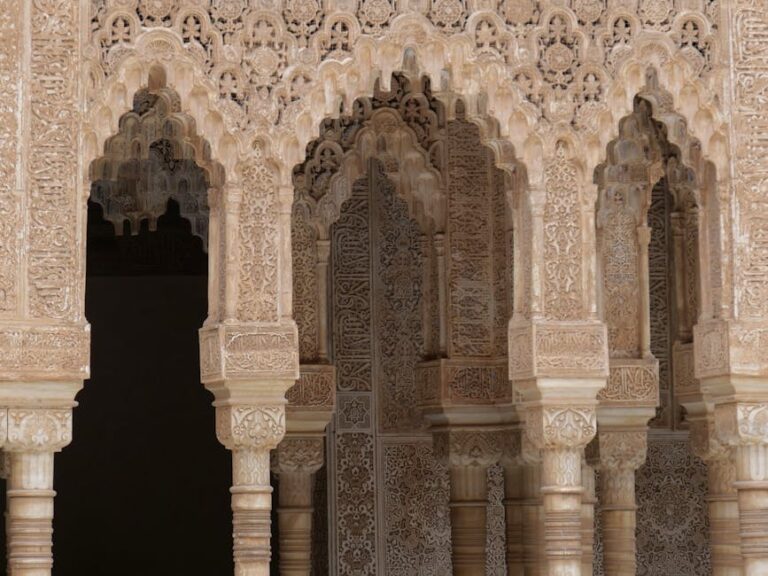
Islamic history and culture of Granada

FrançaisItalianoEnglish

2-Day Granada Itinerary: Explore the City’s Muslim Heritage Step by Step

Introduction — Why this 2-day itinerary for Granada’s Muslim history Granada is one of the most remarkable centers of Islamic civilization in Spain. The city concentrates a unique collection of monuments, neighborhoods and atmospheres that tell more than 700 years of Muslim history: from the Nasrid palaces of the Alhambra to medieval baths, through the winding streets of the Albaicín and Muslim-influenced features preserved in civic buildings. This practical two-day guide is designed to show…

Continue2-Day Granada Itinerary: Explore the City’s Muslim Heritage Step by Step

Music, Poetry & Traditions: Experiencing Muslim Cultural Life in Granada

Introduction — Music, poetry and traditions: Muslim cultural life in Granada Granada is a city where its Muslim past is felt in every stone, down every cobbled lane and in the whisper of the Darro river. Direct heir to the Nasrid emirate, the city is full of monuments, memorial sites and living practices that help explain how Andalusi-Muslim culture shaped local music, poetry and traditions. This introduction offers an immersive overview: how to listen to…

ContinueMusic, Poetry & Traditions: Experiencing Muslim Cultural Life in Granada

Must-See Islamic Museums and Monuments in Granada

Introduction: Why visit Granada’s Islamic museums and monuments Granada is one of Spain’s cultural gems, and its Islamic legacy is woven through the city: architecture, urban planning, gardens, decorative arts and crafts reveal themselves in every stone. This legacy belongs largely to the Nasrid period (1238–1492) — the last Muslim dynasty in Spain — and today is expressed through a group of monuments and museums that are essential for anyone wanting to grasp the city’s…

ContinueMust-See Islamic Museums and Monuments in Granada

Albaicín Neighborhood: Strolls and the Echoes of Muslim Heritage

Introduction — The Living Charm of the Albaicín Perched on the hill opposite the Alhambra, the Albaicín (also spelled Albayzín) is one of Granada’s most atmospheric neighborhoods. Its narrow, winding lanes, whitewashed houses, shaded squares and viewpoints with sweeping views of the Nasrid palace create an ambience where deep history and everyday life mingle. Once an Andalusian medina, the Albaicín still bears visible traces of the Muslim culture that shaped Granada’s urban identity for centuries:…

ContinueAlbaicín Neighborhood: Strolls and the Echoes of Muslim Heritage

Alhambra Visitor’s Guide: History, Art and Islamic Symbols Explained

Introduction: Visiting the Alhambra — history, art and Islamic symbolism The Alhambra in Granada is more than a monument: it’s a vast book carved in stone and stucco, a palace-city that compresses centuries of history, aesthetics and symbolic thought. Perched on the Sabika hill overlooking the city of Granada and the Darro valley, the Alhambra is the finest expression of Andalusian-Moorish art — a place where architecture, calligraphy, geometry and gardening answer one another to…

ContinueAlhambra Visitor’s Guide: History, Art and Islamic Symbols Explained

Granada’s Muslim Roots: Al-Andalus and the Nasrid Legacy

Introduction: Granada’s Muslim roots through the ages For many, Granada is synonymous with the Alhambra, that hilltop palace-fortress that alone captures the imagination of Muslim Spain. But Granada’s Islamic presence, heir to Al-Andalus, goes far beyond that single monument: it’s woven into the street pattern of the Albaicín, the narrow lanes lined with white houses, the surviving baths, the medieval trade routes and even the place names. To understand Granada is to dive into almost…

ContinueGranada’s Muslim Roots: Al-Andalus and the Nasrid Legacy
Découvrez d’autres destinations à explorer . . .

Guide de voyage Urbain Européen   •   Guide de voyage   •   Découvrir la Toscane   •   Guide de voyage Italie   •   Découvrez l'Italie   •   Activités de voyages

© 2026 Grenade.